
St Mary Woolnoth

St Edmund King & Martyr
No matter how many times I make the journey, my attention is always grabbed by the astonishing 1.5m golden grasshopper sign hanging high above my head outside number 68.
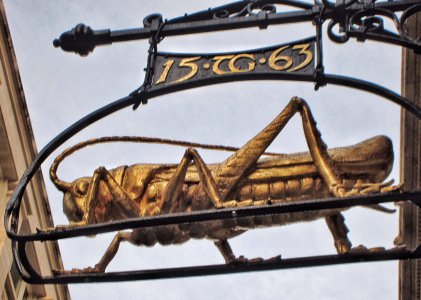
The Lombard Street Grasshopper
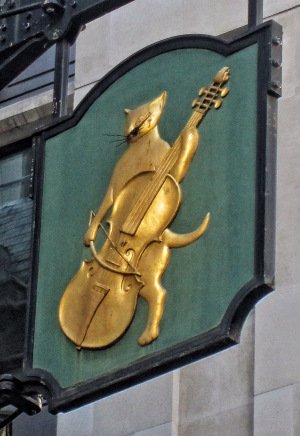
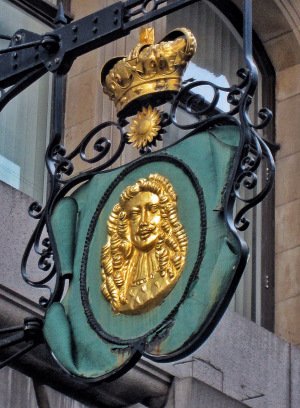
Further up the street there are other old-looking signs, including a Cat and Fiddle and what appears, based on a resemblance to King Charles II, to be The King’s Head & Sun.
Where did these street signs come from, and why? I’ve always imagined them to relate to the banks and other institutions that line the street, and I knew vaguely that the grasshopper had some connection to Sir Thomas Gresham, a Tudor financier and founder of the Royal Exchange who is buried in the nearby church of St Helen, Bishopsgate. But I didn’t know the facts: not only are the signs themselves peculiar, but there appears nothing obvious to explain their linkage to the residents of their respective premises.
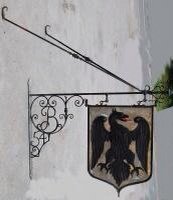
I was therefore delighted recently to acquire a fascinating book, The Signs of Old Lombard Street, published in 1902. This treasure reveals not only the story of the Lombard Street signs - and the important part that its author, Frederick Hilton Price, played in their Edwardian restoration - but also the wider history of British banking including the explanation of how these ancient street signs came to give Barclays and Lloyd’s, two of London’s best known banks, their trademark logos.
Born in 1842, Hilton Price was himself a Lombard Street banker: after joining his father’s firm of Child & Co as a clerk, he worked his way up to become senior partner. With his mutton-chop whiskers, wing collar and cravat (see image below) he looks the epitome of the Victorian City gentleman. In the best Victorian tradition he was also an enthusiastic amateur historian, archaeologist and collector; a fellow of the Royal Geographical Society and the London Topographical Society and President of the Egypt Exploration Fund. In all these fields he researched and published widely. He researched the Lombard Street signs for a paper he presented to the Institute of Bankers in 1887 and published it in book form in 1902.
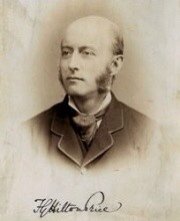
Frederick Hilton Price (1842-1909)
According to Hilton Price, Lombard Street was the site chosen by London goldsmiths for their craft ever since the Norman conquest. The first goldsmiths were Jewish, but after they were expelled from England by Edward I they were replaced by Lombards or Longobards from Italy, the first of whom were the Corsini family. John Stow’s Survey explains that in the reign of Edward II a building was set aside for them between Lombard Street and Cornhill, which became known as the King’s (later the Royal) Exchange. Goldsmiths and banking trades brought wealth and finery to Lombard Street and by the mid 16th century it was considered the finest street in London, a view supported by Pepys after the Great Fire.
London’s business premises adopted street signs to advertise their whereabouts from the earliest times. Given that the vast majority of the population were unable to read or write, the use of visual images to distinguish one shop from another was a useful device. It seems likely that many of these began as inn signs but were then adopted by subsequent tenants of the same premises. As early as 1375, one Simon Leggi, son of a Lord Mayor of London, was trading at The Raven Tavern. By 1560 Thomas Muschamp, a goldsmith to Queen Elizabeth, was trading at the sign of The Ring and Ruby. Around the same time, The Grasshopper made its first appearance outside number 68, being the representation of the family crest of the occupier Sir Thomas Gresham.
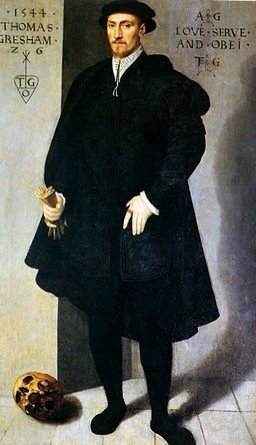
Sir Thomas Gresham (c.1519-1579)
Hilton Price’s study of the records reveals that most of the Lombard Street premises had similar signs, with a remarkable 168 separate signs recorded over the years. He paints a beguiling image of the Tudor street, with the signs…‘swinging over the doors or shop fronts: many projecting far into the roadway in order to attract more attention, and many were fixed to posts in front of the houses.’
This tendency grew, until by the time of King Charles II the signs presented such a nuisance and danger to the public (in several cases the weight of the signs caused the entire front of the premises to collapse into the street) that a law was passed preventing the signs from overhanging the street. After the Great Fire it became the fashion to create the signs out of stone; this led to them becoming almost as great a nuisance as before, until by the mid-18th century they had almost all died away altogether.
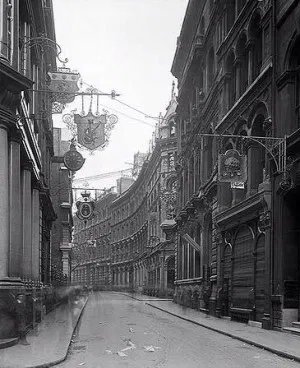
This situation appears to have persisted for 150 years or so until Hilton Price’s day. He remarks that it ‘has of late become fashionable…to replace the old sign of the house’ on the cheques issued by London banks. In 1902 this interest in the old signs gave Hilton Price and his associates the idea of resurrecting as many of them as possible to commemorate the coronation of King Edward VII.
In the end, 23 such signs were erected. They made a rather splendid sight:
Lombard Street in 1902 with signs restored
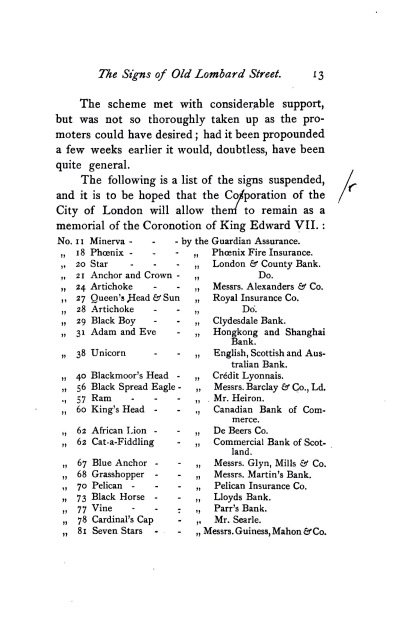
Of the few other remaining signs, the Cat-a-Fiddling seems to have crossed the road and the “Head” of the Queen’s Head & Sun has metamorphosed into that of a King.
Sources
1. Frederick G Hilton Price, The Signs of Old Lombard Street (1902):
2. RBS archives: Frederick Hilton Price
4. Barclays archive: The Spread Eagle
5. Lloyd’s Banking Group: The Black Horse
